Newark homeowners face roofing challenges ranging from Victorian homes in Historic Downtown to working-class neighborhoods shaped by the city's glass manufacturing and Longaberger heritage. Winter Storm Fern dumped a record 11.9 inches of snow across Central Ohio in January, and two March windstorms compounded the damage across Licking County. Here is what every 43055 and 43056 homeowner needs to know in 2026.
Newark is Licking County's largest city with a population of about 50,000 residents. Home to the Newark Earthworks (a UNESCO World Heritage Site candidate), The Works Museum, OSU Newark campus, and the Dawes Arboretum, Newark blends deep history with a growing economy. That history also means the housing stock spans well over a century, from Victorian homes near Downtown Newark Square to mid-century ranches in Cherry Valley and newer construction on the outskirts. Every era of home brings different roofing challenges, and 2026's weather has tested all of them.
Newark Neighborhoods and Their Roofing Challenges
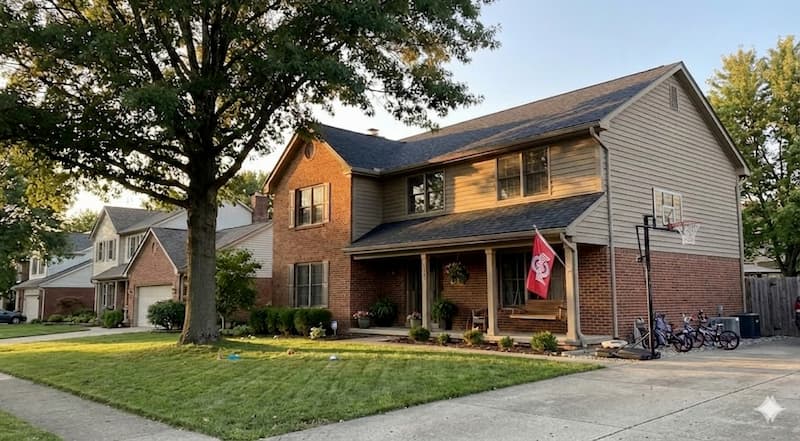
Historic Downtown
Near the Licking County Courthouse and Midland Theatre, Victorian homes, Queen Anne architecture, and Craftsman bungalows feature steep pitches, decorative trim, and original details that require specialized expertise. Improper work on these historic properties can damage irreplaceable architectural features and create leaks that spread through walls and ceilings before you notice them. If your historic Newark home has not had a thorough roof inspection recently, hidden problems may already be developing.
Cherry Valley, Horns Hill, and Little Texas
These areas present terrain-specific risks. Hilltop properties face increased wind exposure, and storm damage you cannot see from the ground may already be shortening your roof's lifespan. Valley locations deal with elevated moisture that accelerates shingle deterioration and promotes algae growth. After 2026's storms, these neighborhoods are particularly vulnerable to hidden damage.
Moundbuilders and Indian Mound Mall Area
Mid-century homes in these neighborhoods are now 40-60 years old. Many are on their third or fourth roof. Builder-grade shingles from the last replacement may be approaching the end of their lifespan, and hidden water damage often goes unnoticed until a leak appears on your ceiling. By that point, you are paying for both roof replacement AND interior repairs.
West Newark and East Newark
Neighborhoods shaped by Newark's industrial heritage (glass manufacturing and the Longaberger Basket Company) often feature modest homes with years of deferred maintenance. Hidden damage may have been developing for decades: leaks that started small and spread through the roof deck, aged flashing that is failing, and ventilation systems that do not meet modern codes. The longer these problems go unaddressed, the more expensive the repair becomes.
2026 Storm Damage in Newark
Newark homeowners have been hit hard in 2026. Here is what happened:
- January 25-26, Winter Storm Fern: The storm dumped 11.9 inches of snow across Central Ohio, breaking the daily record. Level 3 snow emergencies were declared. That heavy snow load created prime conditions for ice dams, where heat from your attic melts the bottom layer of snow, and meltwater refreezes at the eaves, backing up under shingles and into your home.
- March 13: A powerful windstorm with 71 mph gusts swept through Central Ohio. AEP reported 258,000 outages, the worst since 2012. Hilltop properties in Cherry Valley and Horns Hill took the brunt of the wind, which lifts shingles from the decking and breaks the adhesive seal strip.
- March 23: Another 70 mph wind event, this time with 1.4-inch hail confirmed across multiple counties. Back-to-back events like this cause compounding damage that is far worse than any single storm.
If your Newark home has not been inspected since these storms, you may be sitting on hidden damage. Schedule a free inspection or call (614) 304-1197.
Newark Roofing Permits
Newark's permit process requires coordination between two offices. You need zoning approval from the City of Newark at (740) 670-7500, then a building permit from the Licking County Building Code Department at (740) 349-6671. The county office is located at 675 Price Road. The wrong paperwork can delay your project and create compliance issues. DiYanni Roofing handles both applications as part of our service.
Newark Roofing Costs
A typical Newark roof replacement costs between $7,500 and $15,000, depending on your home's size, roof pitch, and the materials you choose. Historic homes with steep pitches and complex roof lines will be at the higher end. Ranch homes in established neighborhoods tend to be more straightforward. Here is a general range:
- Budget-friendly (3-tab shingles): $7,500 to $10,000
- Mid-range (architectural shingles): $10,000 to $13,500
- Premium (designer shingles): $13,500 to $18,000+
Newark Homeowners: Save Up to $1,000
DiYanni Roofing is currently offering up to $1,000 off roof replacement for Newark homeowners. Get an accurate estimate in about 60 seconds with our satellite tool, no salesperson visit required.
Get started: Instant Satellite Estimate | Call (614) 304-1197
Why Newark Homeowners Choose DiYanni
DiYanni Roofing is a fourth-generation family business serving Newark and Central Ohio since 1979. We have 5-star Google reviews, deep knowledge of Newark's neighborhoods and historic architecture, and a commitment to standing behind our work with written warranties. We are not storm chasers. We live and work in Central Ohio, and we will be here when you need us.
Call (614) 304-1197, fill out our contact form, or try our instant satellite estimate to get started.